
Design Empowerment: Community, Culture, and the Power of Place
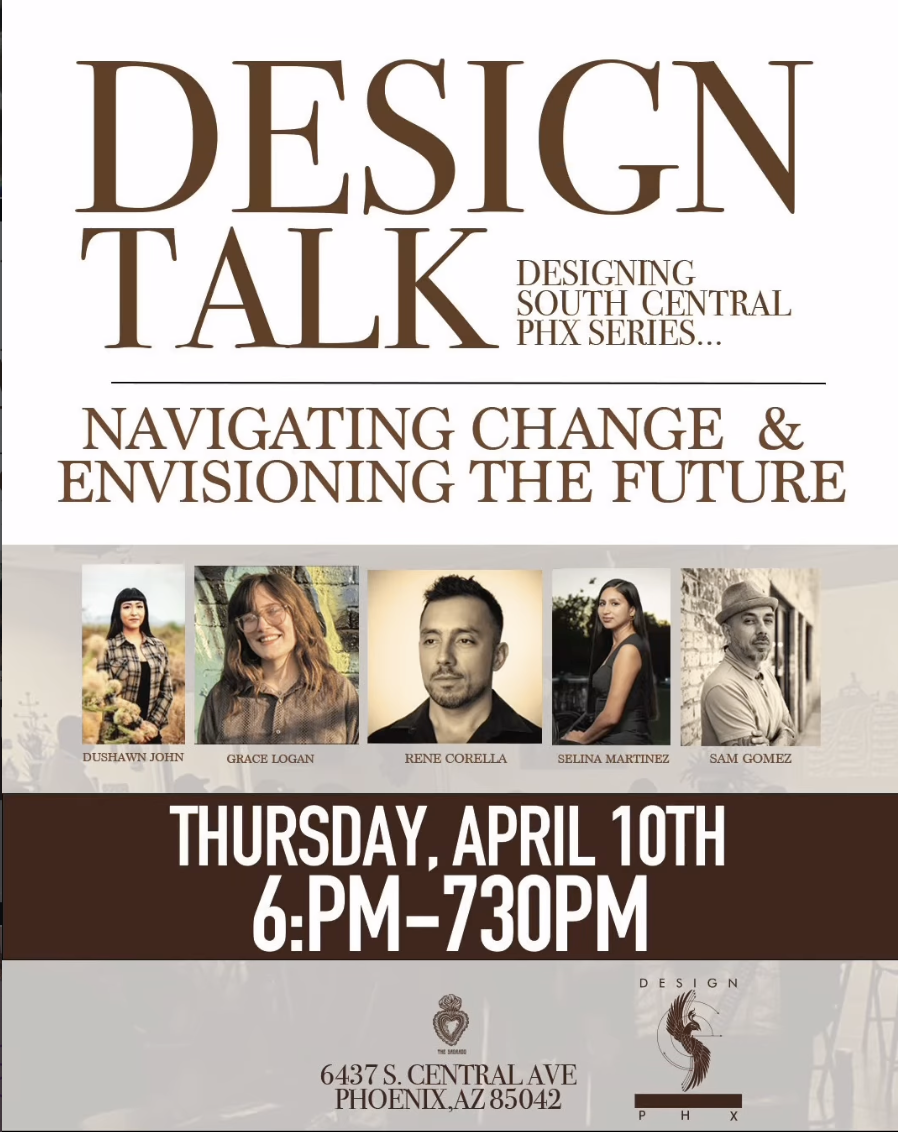
in South Phoenix – April 2025
When development arrives in your neighborhood, you have a choice: freeze up, or find a way to drive it. At Sagrado Galleria, we chose to drive.
Born from displacement, launched after being pushed out of Roosevelt Row, Sagrado understands what it means when large investment enters a community. We know the tension between opportunity and erasure. And we’ve spent years building the tools, relationships, and creative practices to ensure that South Phoenix doesn’t just survive the light rail corridor development - it shapes it.
This design talk brought together to share what we’ve been building together. Here’s what was said and why it matters.
What Is Design Empowerment?
When development drops into your neighborhood, how do you respond? That’s the question at the heart of design empowerment a framework we use to facilitate conversations about power, place, and community identity in the face of change.
Design empowerment means the community doesn’t wait for someone else’s vision. It means creating vision for your community, developing renderings, and showing up to meetings speaking the language of the decision-makers. It’s the feeling of power shifting in a room when community members arrive not with complaints, but with plans.
That power pivoting to uplift community it’s a spiritual approach to navigating bureaucracy.
We decided to be solution-oriented. We advocated for language to be included in the RFQ process for artists for the light rail extension and started workshops to help artists understand how to participate. We took ownership. Are there still community members who are unhappy? Of course. But we chose to meet the moment rather than be consumed by it.
Cultural Chakras: A Spiritual Framework for Urban Design
The concept of Cultural Chakras emerged from a South Central collaborative meeting. It’s a way of thinking about design through the lens of spiritual energy and grounding and yes, people stop when we say that. We embrace it
Our community speaks differently than the bureaucratic way. Rather than starting with the box, the deadline, the budget, we start with grounding and intention. People can feel that intention when it shows up in design.
Central Avenue is the spine of our community. The cultural chakras interact with development along the way spiritual energy centers woven into the built environment. You have to believe there is spatial energy in a place. And then you engage people in pathways to influence that energy through hands-on activities.
Ed Pastor Station: A Dishonor Boarded Up
For the last three years, we have been asking to activate the Ed Pastor transit station even during construction. Anyone who passes through 19th Avenue wonders why nothing is happening there. On the north side, it would already be activated. But in South Phoenix, the only ones using the space are police running K-9 training exercises. The community can’t even access the bathrooms.
Ed Pastor championed this community. It is a dishonor to his legacy to have this station boarded up. It is the longest shade structure in our community, and we aren’t allowed to use it.
It is essential that the Ed Pastor Station be activated with community.
The Salt River: Designing for Future Generations
The Salt River has long been a divider in our community. The question we brought to this work: how can we design space so that future generations can participate in these decisions? How do we create a safe experience at a place that has been known as a hotspot for unhoused neighbors and neglected infrastructure?
The answers are already here. People have ideas. The work is about asking the right questions, questions that invite people to the design table. Through six curated community sessions, surveys on local fauna, and engagement with Indigenous communities and the Audubon Center, we are honoring the fragile ecosystem at the place of protected waters and inviting the community to shape what comes next.
South Phoenix didn’t ask for this bridge. But we leveraged the opportunity to form alliances to push for handrails patterned after creosote bush, for an amphitheater entrance as a place of future engagement, for cultural activation space.
We almost walked away from the default design we were given. But we saw it as an opportunity for more than a movement space. We saw festivals. We saw community. We saw the future.
Youth Imagination and Community Voice
We’ve been running sketch crawls with 7th and 8th graders, inviting their insights into the design process. Youth created incredibly inventive designs, and we showed them: this is the rendering that your imagination created.
Think about what it means for a young person to participate civically in design—rather than waiting for things to happen and not liking them. We are creating pathways for community feedback and harnessing the drawings and dreams of our youth as real tools for change.
While opening concepts about urban environment and design principles, we expose young people to the forces shaping the world around them. The trickle-down effects of that awareness are immeasurable.
Design, Identity, and Indigenous Knowledge Systems
What role does design play in fostering a sense of belonging? Our panelists explored how land-based work is part of our creation stories, shared across cultures—how it connects to the cosmos. We hear catch phrases like “land acknowledgment,” but being in the spirit of doing goes beyond words on a wall.
It means co-design spaces. It means facilitating charrettes with community to understand where shade is needed on the walk to school. It means hearing stories, getting in people’s shoes, and thinking about how they move through the city. It means celebrating identities and cultures through the built environment.
There are real constraints—easements, rights-of-way, archaeological protections. But the vision is clear: plant native species, not the Lowe’s special. Build with what was here originally. Use Indigenous technology systems instead of steel and concrete—structures that dismantle connective opportunity to the land. Build in ways that teach the next generation. Adopt building codes that reflect a position of building in relationship with the earth.
Ambiente: Art as Environmental Justice
Ambiente is a public art installation that displays air quality data through sensor-activated lighting—at night, it comes alive, making visible the environmental injustice that shaped South Phoenix. The highways and industrial corridors built through this community created worse air quality, and Ambiente is a creative tool for engaging the public in that history and its ongoing effects.
The vision started in 2018 as an artistic approach to environmental justice. What can we do to participate in educating community about these social issues? Sagrado adapts and responds to its environment—it’s a blessing to do this work in South Phoenix.
South Phoenix won an award for this work, and now we are trying to leverage that recognition—though it didn’t come with a check. We’ve had setbacks. We see Ambiente as a tool for STEAM education, an anchor for youth to engage in design empowerment,
and a pathway to economic development. We don’t yet have the technology partnerships to scale it. But we’re still pushing to get it to the next phase.
Experimental Shade: Art Meets Extreme Heat
Stinknet. High winds. Extreme weather. How do we mitigate extreme forces bearing down on our community? One answer: experimental shade. Nine different artists were selected to pilot shade structure designs—integrating Chicano and Indigenous aesthetics into the Southwest landscape. This is design as survival. Design as identity. Design as care.
These are basic needs: lighting, pocket parks, safety, and enhanced environments. And the community is showing that art and design can lead the way toward meeting those needs.
To Have a Vision, You Need to Know Your History
The Audubon Center sits on what was once a landfill. Ed Pastor was the champion of that transformation. The history of redlining, the railroad, the South Phoenix flood plain—when we are coherent about this history, every decision carries a different weight.
Each of us brings an understanding of place. The work is about weaving together the parallel efforts we are each carrying—building connections with each other and bringing people together. Creating space and demanding that space be built. We had to rally to get the funding we needed. We went to institutions and advocated for support.
A Call to the Community
If you take one thing from this conversation, let it be this: the needs of the community must create the design that sets the stage for the future. Not the other way around.
Go to the board meetings. Get there in the beginning—not at the end. Take subconsultant opportunities and push them toward fostering community evolution. Be a steward of the environment. Advocate for funding so organizations can activate the spaces being built.
Design can lead. But only if we are at the table.
Notes from a live talk at the Sagrado Gallería
South Phoenix, Arizona
Rooted in community. Driven by design. Guided by spirit.