
The Land Remembers,and So Do We
Community Stewardship in South Phoenix & Central City
A Sagrado Galleria Design Talk Recap
We opened the way we begin all things at Sagrado with poetry, with prayer, with permission. Abby Lopez offered her words, from the Protectors of the Salt River, with her son present, grounding us in the understanding that stewardship is a lived practice, carried between generations.
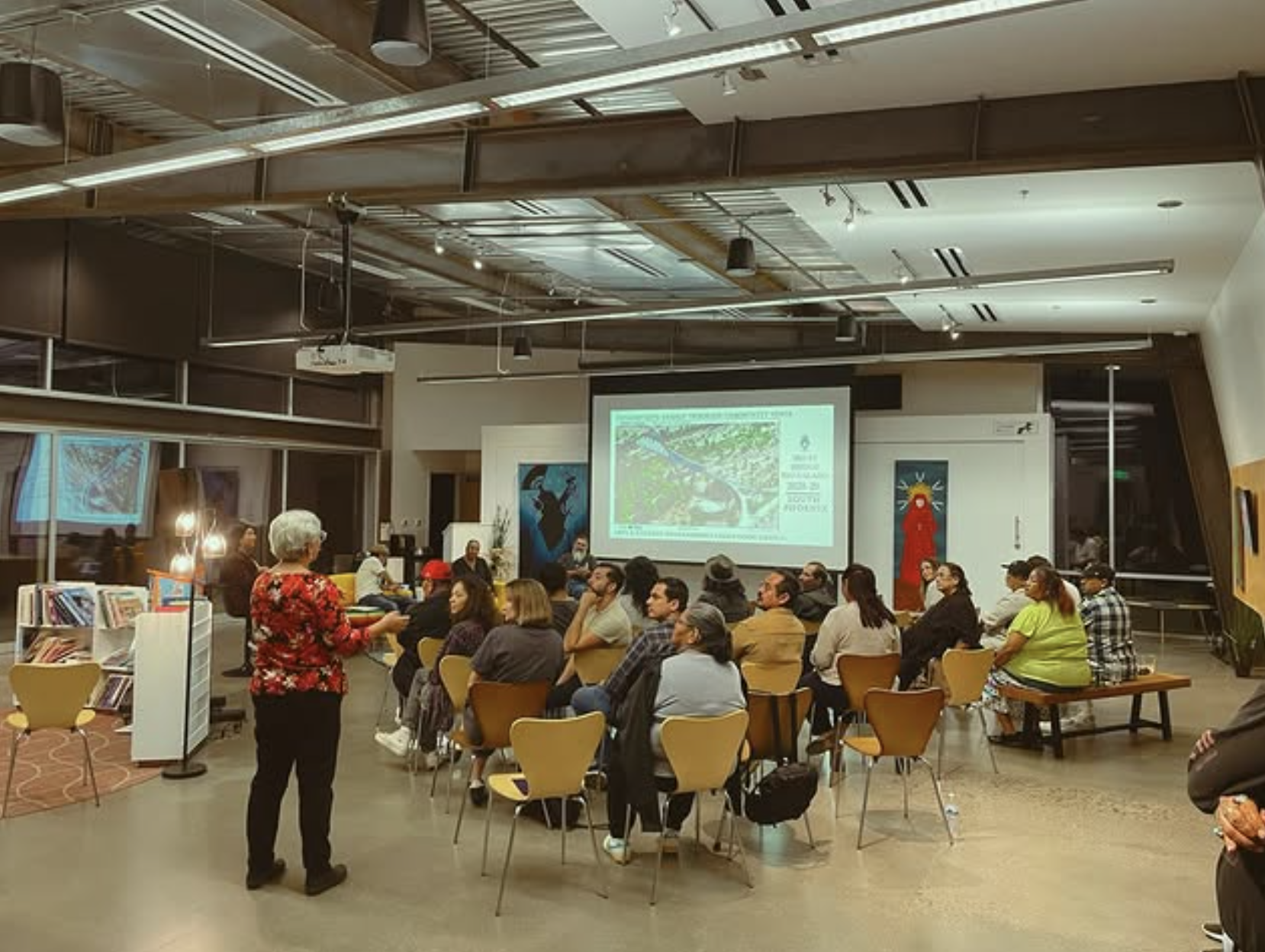
What followed was one of the most powerful community design conversations we have ever hosted. By the time the evening was through, nearly fifty people had filled the room: elders, organizers, architects, neighbors, and young people each carrying a piece of the story of South Phoenix and Central City. Each one a steward.
This was a gathering of people who have stayed. People who have buried their loved ones here and kept building anyway. People who measure time not in fiscal years or project timelines, but in the generations before them and the generations still coming.
✦ ✦ ✦
The River Remembers
DJ, an architectural designer and employee of the Salt River Yavapai community, opened the design conversation by reframing everything. Before the freeways. Before the mining. Before the canals were “engineered.” The Salt River was alive older than the Mississippi and the Sonoran Desert was a wetland, teeming with an ecosystem that had its own agency, its own relationships.
Then came policy. And policy did what policy was designed to do: it removed people from the land. It reduced ecosystems, animals, and human beings into resources to be extracted. Industry moved in. The river became a dumping ground. Native people and native species were displaced together. And the heat- the extreme, compounding heat rose from that very wound.
“The path to regeneration is through language, land, and people. Native species and native people. Design can serve healing.” — DJ
This is where design enters, as a reckoning. If we understand what was taken, we can begin to imagine what restoration looks like. The land holds that memory. So do the people still connected to it.
✦ ✦ ✦
Thirteen Years of Showing Up
Eva spoke about what it means to ensure residents have real agency in the changes happening around them not the performed version of engagement where someone hands you a survey, but the kind rooted in relationship and belonging.
Eva remembers the river as a dump. She has spent thirteen years as a Central City planner the kind who walks the land with her neighbors, translates between languages and power structures, and has learned how to be a policy mover because the conditions demanded it.
“We have to learn to be policy movers, urban planners, and water stewards to make change happen. Nobody is going to do it for us.”
She raised Grant Park as a case study a single-family-home community where four-story buildings appeared and destroyed historic structures. No one from the neighborhood was part of those decisions. The consultants came on their timelines, not on the community’s.
“Central City South is not opposed to development. We need a grocery store, we need jobs. But it needs to be friendly to what already exists here the people and the built environment.”
Eva co-chairs the committee overseeing the abandoned lots near the airport. She walks the land with community members to translate what is happening and to empower people to show up for themselves. This is what real engagement looks like boots on the ground with people who have been here.
✦ ✦ ✦
Sixty-Eight Years in South Phoenix
Fernando Ruiz of the Phoenix Revitalization Corporation arrived with his wife, his daughter, and his granddaughter—three generations in one room. He has been in South Phoenix for sixty-eight years. Forty-nine of those years married. By the time he spoke, the room had swelled to fifty people.
He told us about the neighborhood near Central and Roosevelt held fifteen hundred years of human presence. Artifacts still turning up in the soil. Indigenous ball courts once stood where parking lots sit now. He imagines the families who lived here, looking up at the same stars, wondering about the future of their children—the way he does today.
“Place a plaque. Tell me about who was here before me in my neighborhood. We know people lived here fifteen hundred years ago. There are still ancient remains here. This was a thriving Indigenous community.”
When the city proposed five- and six-story buildings in an area that is entirely single-family homes, Fernando asked his neighbors what they thought. The answer was simple: Why should we build up so high? It doesn’t make sense for our environment. What will this place look like a hundred years from now?
Fernando is of Catholic missionary descent and identifies as Chicano. He pushed back on the assumption that South Phoenix communities function the way developers expect American neighborhoods to function.
“We are America—if you don’t forget the rest of the continent, north and south. People migrate for a reason. They don’t do that for fun.”
He marveled at the canal system—dug with sticks by Indigenous hands—that still sustains the Valley to this day. And he asked the question that should be on every planning document in the state: What’s the next hundred years for Arizona? Who is taking our water? What are we going to do about it?
✦ ✦ ✦
We Stayed
Fernando told the room what staying actually costs. His community has buried its young. They have survived violence, loss, and decades of disinvestment. And they stayed.
“People told us to go to Chandler, to other more wealthy areas in the Valley. But we chose to stay in South Phoenix. We have generations here, and we will stay and protect it.”
South Phoenix is home to the largest food bank in the area, feeding six thousand people a month. The community built its own charter school—the oldest in Arizona—because nobody else was going to do it for them.
“If you are not willing to commit to community, don’t build here.”
He turned to the room and said something that should echo through every engagement process in every city: You don’t need credentials to speak up.
✦ ✦ ✦
What Real Engagement Looks Like
The conversation turned to what community engagement actually means—not as a line item in a grant budget, but as a way of being.
“We are in relationship with the community. They come to us and tell us what they need. We are already in relationship beyond any specific project.”
The group discussed the ongoing tension with developers who arrive with financing already secured and only need to check a box for “resident input.” District 7’s Councilmember has pushed for developers to partner with smaller, community-rooted developers. Some have committed to reinvesting profits back into the neighborhood.
But the fundamental disconnect remains: the city approves eight-story buildings in communities that have been single-family for generations. During the light rail extension, officials talked about “neighborhood character” while ignoring the people who define that character.
“Why did you come to community and not listen to them? This is about people. Do you know three of your neighbors? The design now answers: you don’t interact.”
✦ ✦ ✦
Ed Pastor Station and the Future of Central
The room spoke about the Ed Pastor Station with both grief and vision. What the city has done with it is wrong, they said but there is a plan. It should feel like First Fridays on Roosevelt: art, family, food, gathering. Not another cluster of eight-story buildings approved without community consent.
“What would we say a hundred years from now? That they built a lot of apartments? Fear of displacement is real. How do we manage the change coming and not be pushed out?”
The community is asking for buildings that feel comfortable next to the single-family home next door. Come and blend in with us. Welcome diversity English, Spanish, Mandarin are spoken at our meetings now. But come with respect for what is already here.
✦ ✦ ✦
Zoning, Eminent Domain, and the Fight to Stay
The conversation grew more urgent as residents raised the realities of zoning that works against them. VFWs and corner bars sit in R3 and R1 zones with liquor licenses grandfathered in. Meanwhile, neighboring properties could become nightclubs under current rules. The city won’t allow rezoning, and retroactive zoning leaves communities trapped.
Then came the word no one wants to hear: eminent domain. Properties can be taken. Utilities and the city have that power. One community member described a property offered one million, then two, then up to seven million—taken, and they received nothing.
At Roadrunner, four hundred families own their trailers but not the land beneath them. If a trailer is over ten years old, it can’t be moved. Renters have no rights when the property owner sells. The room agreed: we need good lawyers. We need to talk to landlords, to tribal leaders about water rights, to the companies trying to own what flows beneath us.
✦ ✦ ✦
The Beavers Fixed It
In the middle of the heaviest conversation of the evening, someone told this story: a canal broke on the Salt River. Civil engineers worked on it for months. The beavers fixed it.
The room laughed, but the lesson was real. Nature knows how to repair what has been broken. Communities do too—when they are trusted, resourced, and left to do what they already know how to do.
✦ ✦ ✦
What We Need at the Table
As the evening closed, the asks were clear and grounded:
• The Planning Department at the table—not after decisions are made, but while vision is being shaped
• Small-group discussions with decision makers before they destroy our barrios
• Spanish-speaking neighbors included in every conversation
• Tribal nations and casinos at the table—their twelve percent gaming contributions are part of this region’s future
• Historic district designation to protect what still stands
• Community stakeholders—Developers, Decision makers, Council Representatives—present and accountable
This community has already purchased fifteen homes through Phoenix LISC at $110,000 each. Five years later, they are worth $300,000. The investment is working. The commitment is real. The question is whether the city and its partners will match it.
✦ ✦ ✦
With love and solidarity,
Sagrado Galería
South Phoenix